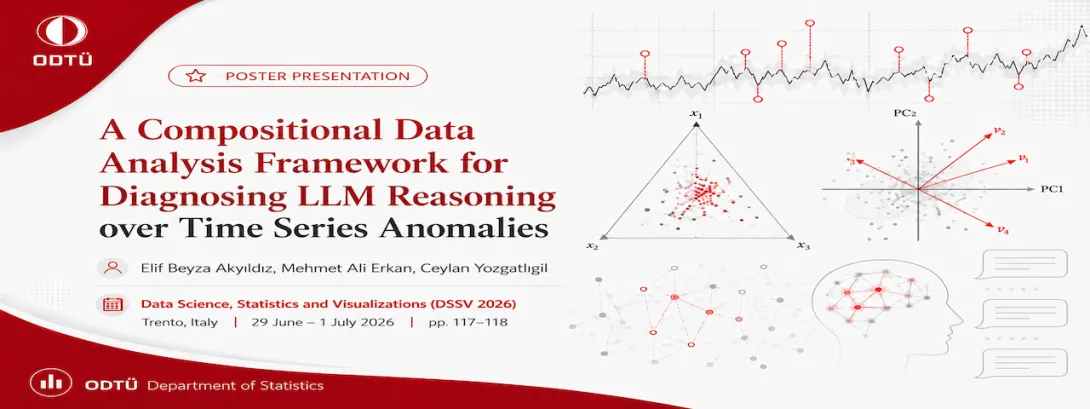
The study titled “A Compositional Data Analysis Framework for Diagnosing LLM Reasoning over Time Series Anomalies,” authored by Elif Beyza Akyıldız, Mehmet Ali Erkan, and Ceylan Yozgatlıgil, was presented as a poster at the Data Science, Statistics and Visualizations Conference (DSSV 2026), held in Trento, Italy, from 29 June to 1 July 2026.
The study investigates how large language models distribute their attention across different sensor channels when reasoning about anomalies in multivariate time series. Applying conventional multivariate analysis methods directly to these attention distributions may overlook their compositional structure and produce misleading relationships. In the proposed framework, attention distributions are first transformed using the centered log-ratio transformation and then mapped into a more interpretable space through principal component analysis. Biplot visualizations jointly represent attention compositions and sensor contributions, allowing attention allocation, variable influence, and anomaly detection performance to be examined simultaneously.
The framework was evaluated on the RATS-40K benchmark using a range of instruction-tuned large language models across multiple sensor domains and anomaly types. Requiring only model attention outputs and generalizing across different domains and model architectures, the method provides a simple and explainable framework for assessing the reliability of large language models in multivariate time series reasoning.